


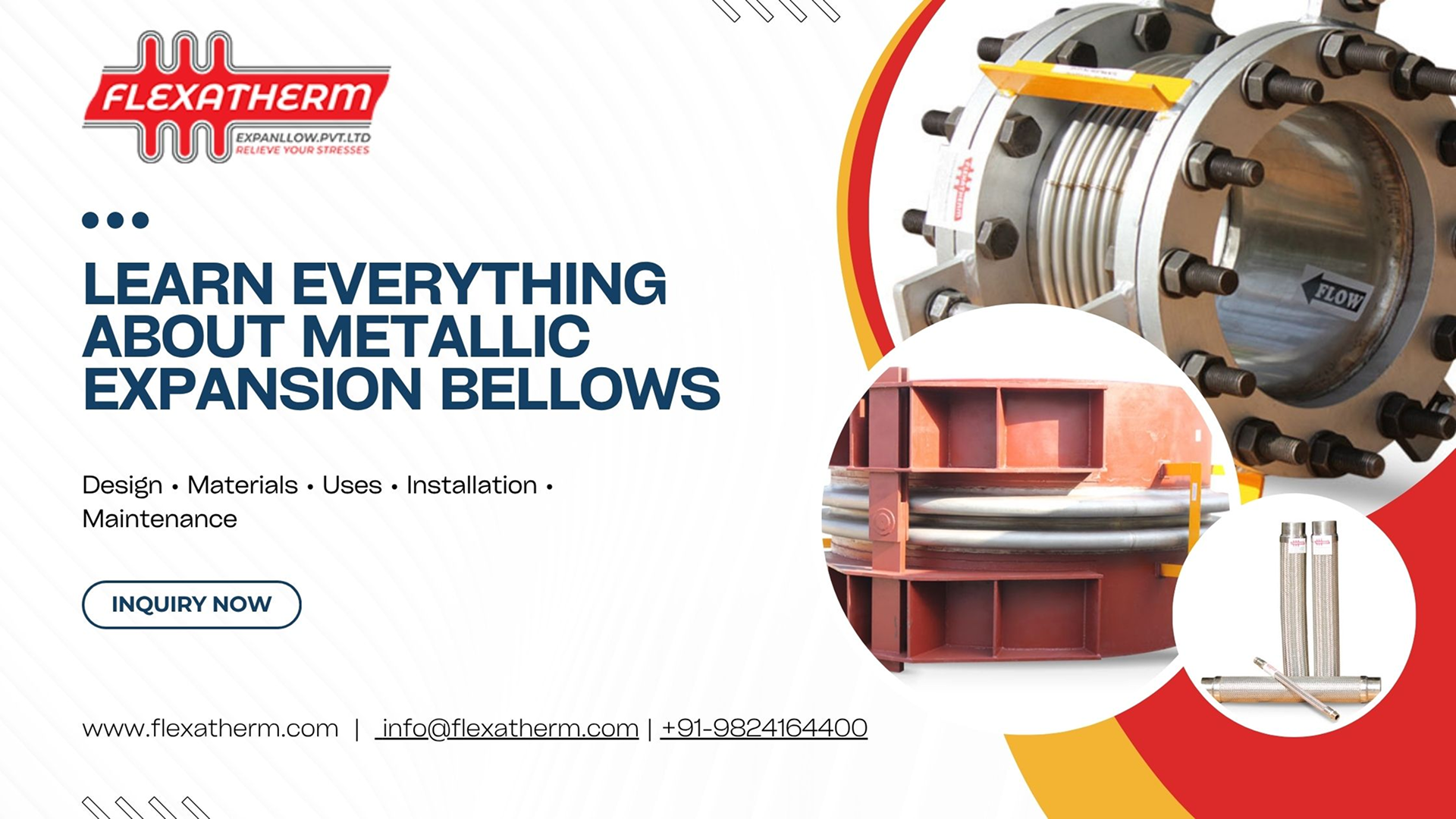
What Are Metallic Expansion Bellows?
Metallic expansion bellows are flexible metal components designed to absorb movement, vibration, pressure, thermal expansion, and mechanical stress in piping systems, ducts, and industrial equipment. These bellows are engineered with corrugated metal structures that allow them to expand, contract, bend, or shift without damaging the connected system.
In simple terms, metallic expansion bellows (joints) act as flexible connectors that protect pipelines and machinery from stress caused by temperature changes, pressure fluctuations, or operational movement. They are widely used in industries such as oil and gas, power generation, chemical processing, HVAC, marine, aerospace, and manufacturing.
The primary purpose of metallic bellows is to increase the lifespan of industrial systems while improving safety, efficiency, and reliability.
Understanding Metallic Expansion Bellows
Industrial pipelines and equipment constantly experience movement due to heat, vibration, pressure, or mechanical operations. Without flexibility in the system, this movement can lead to cracks, leaks, equipment failure, or expensive maintenance.
Metallic expansion bellows solve this problem by absorbing and compensating for:
- Axial movement
- Lateral movement
- Angular movement
- Thermal expansion
- Mechanical vibration
- Pressure surges
- Misalignment
These bellows are specially designed to maintain pressure integrity while remaining flexible enough to handle movement in demanding industrial environments.
How Metallic Expansion Bellows Work
Metallic expansion bellows operate through a corrugated metal structure that compresses or expands when movement occurs within a pipeline or equipment system.
When temperature increases, metal pipes expand naturally. When temperature decreases, pipes contract. This constant movement creates stress on joints, supports, valves, and machinery. Metallic bellows absorb this movement and reduce strain on the system.
The flexible corrugations allow the bellows to:
- Stretch during expansion
- Compress during contraction
- Flex during vibration
- Bend during angular movement
This controlled flexibility protects the entire system from damage.
Main Components of Metallic Expansion Bellows
A metallic expansion bellows assembly generally consists of several important components:
1. Bellows Element
The bellows element is the flexible corrugated section responsible for movement absorption. It is usually made from stainless steel or other corrosion-resistant alloys.
2. End Connections
End fittings connect the bellows to pipelines or machinery. Common end connections include:
- Flanged ends
- Welded ends
- Threaded connections
- Pipe ends
3. Tie Rods
Tie rods control movement and prevent overextension of the bellows.
4. Internal Sleeve
An internal sleeve protects the bellows from turbulence, erosion, or high-velocity flow.
5. External Cover
External covers protect the bellows from external damage, dust, moisture, or environmental exposure.
Types of Metallic Expansion Bellows
Different industrial applications require different types of metallic bellows. Below are the most common types used across industries.
Axial Expansion Bellows
Axial bellows absorb movement along the length of the pipe. These are the most common type used in straight piping systems.
Features:
- Handles thermal expansion
- Compact design
- Cost-effective
- Easy installation
Applications:
- Steam lines
- Hot water systems
- Industrial pipelines
Lateral Expansion Bellows
Lateral bellows absorb sideways movement between connected pipes.
Features:
- Suitable for offset pipelines
- Reduces pipe stress
- Handles large lateral displacement
Applications:
- Chemical plants
- HVAC systems
- Power plants
Angular Expansion Bellows
Angular bellows absorb rotational or angular movement between pipes.
Features:
- Ideal for directional changes
- Flexible joint design
- Excellent stress reduction
Applications:
- Turbine systems
- Aerospace piping
- Marine applications
Universal Expansion Bellows
Universal bellows consist of two bellows connected by a center pipe. They can absorb combined axial, lateral, and angular movements.
Features:
- Multi-directional flexibility
- Increased movement capability
- Improved system protection
Applications:
- Complex piping systems
- Industrial processing plants
- High-temperature operations
Pressure Balanced Bellows
Pressure-balanced bellows are designed to absorb movement while neutralizing pressure thrust forces.
Features:
- Minimizes pressure loads
- Protects sensitive equipment
- Ideal for high-pressure systems
Applications:
- Pump systems
- Compressor lines
- Turbine installations
Materials Used in Metallic Expansion Bellows
The material selection for metallic bellows depends on pressure, temperature, corrosion resistance, and operating environment.
Stainless Steel
Stainless steel is the most commonly used material because of its excellent corrosion resistance and durability.
Benefits:
- High strength
- Corrosion resistance
- Long service life
- Cost-effective
Common grades include:
- SS304
- SS316
- SS321
Inconel
Inconel is a nickel-based alloy used for extreme temperature and pressure conditions.
Benefits:
- Excellent heat resistance
- Oxidation resistance
- High mechanical strength
Applications include:
- Aerospace
- Gas turbines
- Chemical processing
Hastelloy
Hastelloy is used in highly corrosive chemical environments.
Benefits:
- Superior chemical resistance
- Long lifespan
- High reliability
Monel
Monel is suitable for marine and seawater applications due to excellent saltwater resistance.
Benefits:
- Corrosion resistance
- Strong mechanical properties
- Marine durability
Advantages of Metallic Expansion Bellows
Metallic expansion bellows provide numerous operational and engineering advantages.
Absorbs Thermal Expansion
Pipes expand and contract due to temperature changes. Bellows absorb this movement and prevent stress damage.
Reduces Vibration
Industrial machinery generates vibration that can damage pipelines and connected equipment. Metallic bellows reduce vibration transmission.
Prevents Equipment Damage
Bellows minimize stress on:
- Pumps
- Compressors
- Turbines
- Valves
- Heat exchangers
This increases equipment lifespan.
Handles High Pressure and Temperature
Metallic bellows can withstand extreme industrial conditions better than rubber or fabric expansion joints.
Improves System Safety
By preventing cracks, leaks, and pipe failures, metallic expansion bellows improve workplace safety and operational reliability.
Minimizes Maintenance Costs
Properly installed bellows reduce pipeline failures and downtime, leading to lower maintenance expenses.
Applications of Metallic Expansion Bellows
Metallic expansion bellows are used in nearly every industrial sector.
Oil and Gas Industry
In oil refineries and gas plants, pipelines carry high-pressure fluids at extreme temperatures. Bellows absorb thermal movement and vibration.
Common Uses:
- Refinery pipelines
- Offshore platforms
- Gas transmission systems
Power Generation Plants
Power plants use metallic bellows in steam lines and turbine systems.
Applications:
- Boiler systems
- Steam pipelines
- Turbine exhaust systems
Chemical Processing Industry
Chemical plants require corrosion-resistant bellows capable of handling aggressive chemicals.
Applications:
- Acid transfer lines
- Chemical reactors
- Processing systems
HVAC Systems
Heating, ventilation, and air conditioning systems use bellows to reduce vibration and thermal stress.
Benefits:
- Noise reduction
- Improved system flexibility
- Longer equipment life
Marine Industry
Ships and offshore systems experience constant vibration and movement. Metallic bellows improve system durability.
Applications:
- Engine exhaust systems
- Marine piping
- Shipbuilding
Aerospace Industry
Aircraft and aerospace systems require lightweight and highly durable bellows.
Applications:
- Fuel systems
- Hydraulic systems
- Engine assemblies
Pharmaceutical Industry
Pharmaceutical manufacturing requires hygienic and corrosion-resistant piping systems.
Applications:
- Sterile processing
- Cleanroom systems
- Fluid transfer lines
Metallic Expansion Bellows vs Rubber Expansion Joints
Many industries compare metallic bellows with rubber expansion joints before selecting the right solution.
| Feature | Metallic Bellows | Rubber Expansion Joints |
|---|---|---|
| Temperature Resistance | Very High | Moderate |
| Pressure Capacity | High | Lower |
| Durability | Excellent | Moderate |
| Chemical Resistance | Excellent | Depends on rubber type |
| Flexibility | Moderate | High |
| Lifespan | Longer | Shorter |
| Maintenance | Lower | Higher |
Metallic expansion bellows are preferred for high-pressure and high-temperature applications.
Design Considerations for Metallic Expansion Bellows
Proper design is critical for long-lasting performance.
Pressure Rating
The bellows must withstand internal system pressure without deformation.
Temperature Range
Material selection should match the operating temperature.
Movement Requirements
Engineers must calculate:
- Axial movement
- Lateral displacement
- Angular rotation
Cycle Life
Cycle life refers to the number of expansion and contraction cycles the bellows can handle before failure.
Corrosion Resistance
The selected material must resist chemicals, moisture, or environmental exposure.
Manufacturing Process of Metallic Expansion Bellows
The manufacturing process involves precision engineering and strict quality control.
Step 1: Material Selection
The appropriate metal alloy is selected based on operating conditions.
Step 2: Tube Forming
Metal tubes are prepared to form the base structure.
Step 3: Corrugation Formation
Corrugations are created using:
- Hydraulic forming
- Mechanical forming
- Roll forming
Step 4: Welding
End fittings and additional components are welded carefully.
Step 5: Heat Treatment
Heat treatment improves flexibility and material strength.
Step 6: Testing
Each bellows undergoes multiple tests to ensure quality and performance.
Testing Methods for Metallic Expansion Bellows
Quality testing ensures safe operation in industrial systems.
Hydrostatic Testing
Bellows are tested under pressure to identify leaks or weaknesses.
Pneumatic Testing
Air pressure testing verifies structural integrity.
Dye Penetrant Inspection
This test detects surface cracks or welding defects.
Cycle Testing
Bellows are repeatedly expanded and compressed to measure lifespan.
Dimensional Inspection
Engineers verify size, thickness, and corrugation accuracy.
Installation Guidelines for Metallic Expansion Bellows
Correct installation is essential for optimal performance.
Proper Alignment
Pipes must be aligned correctly before installation.
Avoid Overextension
Bellows should never exceed their designed movement limits.
Use Correct Supports
Pipe supports and anchors prevent excessive stress.
Protect Against Torsion
Bellows are not designed to absorb twisting unless specifically engineered for torsional movement.
Follow Manufacturer Instructions
Always follow installation specifications provided by the manufacturer.
Common Problems in Metallic Expansion Bellows
Like any industrial component, bellows can fail if not properly designed or installed.
Fatigue Failure
Repeated movement over time may cause metal fatigue.
Causes:
- Excessive movement
- Poor design
- High cycle operation
Corrosion Damage
Chemical exposure or moisture may weaken the metal surface.
Overpressure Failure
Pressure exceeding design limits can rupture the bellows.
Improper Installation
Incorrect alignment or lack of supports may lead to early failure.
Maintenance Tips for Metallic Expansion Bellows
Routine maintenance increases lifespan and performance.
Regular Inspection
Inspect for:
- Cracks
- Corrosion
- Deformation
- Leakage
Monitor Vibration Levels
Excessive vibration may damage bellows over time.
Check Supports and Anchors
Loose supports increase stress on the bellows assembly.
Clean External Surfaces
Remove dirt, chemicals, or debris from external surfaces.
Industry Standards Followed by Flexatherm for Metallic Expansion Bellows
At Flexatherm, quality, safety, and engineering precision are maintained through internationally recognized standards for metallic expansion bellows manufacturing and testing. These standards ensure reliable performance, durability, and compliance for industrial applications across various sectors.
- EJMA Standards – Expansion Joint Manufacturers Association guidelines for design and testing
- ISO Certifications – International quality management compliance
- ASME Compliance – American Society of Mechanical Engineers pressure vessel and piping codes
Future Trends in Metallic Expansion Bellows
Technological advancements continue to improve metallic bellows performance.
Advanced Alloys
New metal alloys offer:
- Higher corrosion resistance
- Better heat tolerance
- Longer lifespan
Smart Monitoring Systems
Sensors can monitor:
- Pressure
- Temperature
- Fatigue levels
- Vibration
This helps prevent unexpected failures.
Lightweight Designs
Modern industries seek lightweight yet durable bellows for aerospace and automotive applications.
Choosing the Right Metallic Expansion Bellows Manufacturer
Selecting a reliable manufacturer is essential for product quality and long-term performance.
Look for Industry Experience
Experienced manufacturers understand complex industrial requirements.
Check Certifications
Ensure the company follows:
- EJMA standards
- ISO certifications
- ASME compliance
Evaluate Material Quality
High-grade materials improve durability and safety.
Ask About Customization
Different applications require customized solutions.
Review Testing Procedures
Reliable manufacturers conduct extensive testing before delivery.
Why Metallic Expansion Bellows Are Important in Modern Industry
Modern industries depend on reliable piping and equipment systems. Without movement compensation, industrial operations would face constant failures, downtime, and safety risks.
Metallic expansion bellows help industries:
- Improve operational efficiency
- Reduce maintenance costs
- Enhance safety
- Increase equipment lifespan
- Handle extreme conditions
They are essential components in systems where flexibility and reliability are critical.
Frequently Asked Questions About Metallic Expansion Bellows
Metallic expansion bellows absorb thermal expansion, vibration, pressure fluctuations, and mechanical movement in industrial systems.
Common materials include stainless steel (SS304, SS316, SS321), Inconel, Hastelloy, and Monel.
They are used in oil and gas, power plants, HVAC, chemical processing, marine, aerospace, and manufacturing industries.
The lifespan depends on:
- Material quality
- Operating conditions
- Installation
- Maintenance
- Cycle frequency
Properly maintained bellows can last for many years.
Yes, metallic bellows are specifically designed for high-temperature and high-pressure environments.
Common causes include:
- Fatigue
- Corrosion
- Overpressure
- Improper installation
- Excessive movement
Conclusion
Metallic expansion bellows play a critical role in protecting industrial piping systems and equipment from thermal expansion, vibration, pressure changes, and mechanical stress. Their flexible corrugated design allows systems to operate safely and efficiently under demanding conditions.
From power plants and refineries to HVAC systems and aerospace applications, metallic bellows provide durability, flexibility, and long-term reliability. With proper material selection, design, installation, and maintenance, these components significantly improve industrial performance while reducing operational risks and maintenance costs.
As industries continue to advance, metallic expansion bellows will remain essential for modern engineering systems that require safe, flexible, and efficient movement compensation solutions.
Looking for high-quality metallic expansion bellows for your project?
Explore Flexatherm's complete range of metallic expansion joints, engineered for precision and built to last. Get expert guidance and custom solutions today.
Contact Our Experts